
Collecting · 6 min read
Why Fine Art Prints Cost What They Do
Not margins — inputs. What a 1200 ppi Lumachrome or Supralume print actually costs to make, and why a 48×72 costs more than four 24×36s.
A large fine art print costs more than most people expect, and the usual explanation — "it's handcrafted, it's archival, it's limited" — is true but unsatisfying, because every seller says exactly that. So here's the actual structure of the number, and the parts of it that are genuinely unavoidable.
The short version. You're buying an object, not a file. Materials and lab work scale with area, which grows fast. Past about 40 inches everything ships crated, which is a real step. And buying direct means no gallery is taking a cut of it.
You're buying an object, not a photograph
The photograph is free, in the sense that it already exists and I'd have made it anyway. What you're paying for is the thing that arrives at your door: a physical object built to a spec, by a lab, out of materials that cost real money, and then packed and freighted to you intact.
That distinction explains most of the price structure. It's why a bigger version of the same image costs meaningfully more — nothing about the file changed, but everything about the object did.
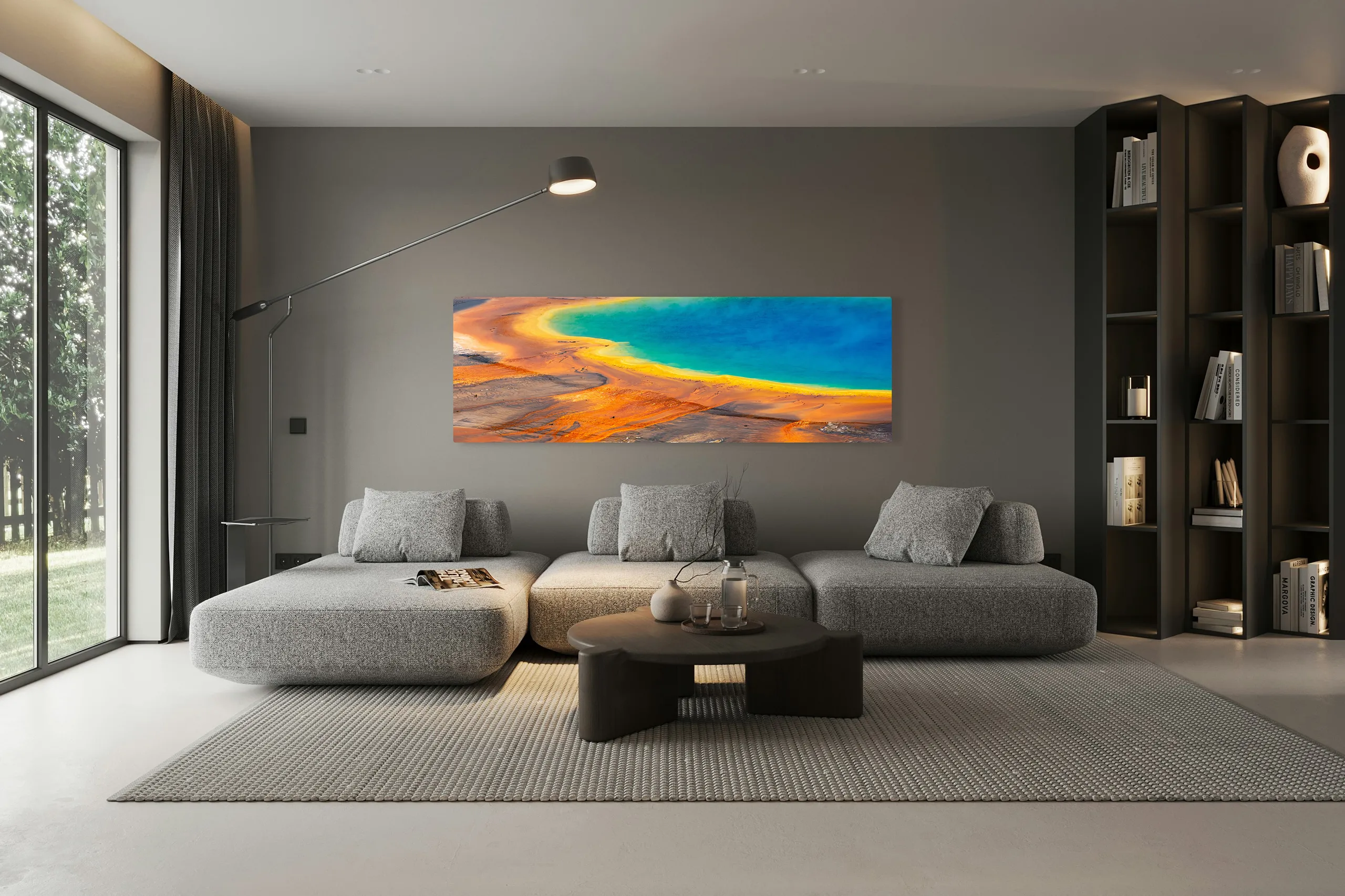
What actually goes into it
- The print. Lumachrome and Supralume pieces are produced at 1200 ppi and 16-bit — four times the resolution of a standard 300 ppi print and 65,000 tonal steps per channel instead of 256. That's not marketing; it's the difference between smooth gradation in a sky and visible banding at scale.
- The substrate and mount. Acrylic, aluminum, cotton rag — the materials themselves, plus face-mounting or bonding, which is skilled labor with a real scrap rate. A face-mount that goes wrong is a total loss, not a do-over.
- Packing, crating and freight. Covered below, because past a certain size this stops being a line item and becomes a major one.
- Insurance and replacement. Every piece ships insured, and if one arrives damaged I replace it. That risk is priced in rather than passed to you.
- The edition. An image released in an edition of 50 can only ever be sold 50 times. That's a real constraint on the economics, and it's the trade you're making for the piece not being infinitely reproducible.
Area is the driver, and area grows fast
This is the part that surprises people. Doubling the long edge of a print doesn't double it — it quadruples it. A 48 × 72 is exactly 4.0× the surface area of a 24 × 36, not twice as much. Every material cost, every handling cost, and every bit of risk scales with that surface, which is why the ladder climbs the way it does.

But the big ones are better value, not worse
Here's the counterintuitive part, and it's checkable against the published prices. While the total goes up with size, the price per square inch goes steadily down. A 48 × 72 has 4.0× the area of a 24 × 36 but costs only 2.45× as much in Lumachrome.
| Size | Area | Paper | per sq in | Lumachrome | per sq in |
|---|---|---|---|---|---|
| 16 × 24 | 384 in² | $245 | $0.64 | $1,550 | $4.04 |
| 20 × 30 | 600 in² | $325 | $0.54 | $2,000 | $3.33 |
| 24 × 36 | 864 in² | $425 | $0.49 | $2,450 | $2.84 |
| 30 × 45 | 1,350 in² | $625 | $0.46 | $3,000 | $2.22 |
| 40 × 60 | 2,400 in² | $1,110 | $0.46 | $4,375 | $1.82 |
| 48 × 72 | 3,456 in² | $1,600 | $0.46 | $6,000 | $1.74 |
From the smallest to the largest, the cost per square inch of an acrylic piece falls by about 57%. So the honest framing is: the big pieces are expensive in absolute terms and the best value on the wall. If you're weighing two sizes, that's worth knowing before you default down.
The step at 40 inches
Past roughly 40 inches on the long side, a piece can no longer ship in a box — it travels in a purpose-built crate, on a freight carrier, with different handling at both ends. That's a genuine step change in cost rather than a surcharge I've invented, and it's the main reason the ladder steepens near the top.
It doesn't change what you should buy. It's just worth knowing that the jump from a 30-inch to a 40-inch long edge is a bigger jump than the ten inches suggest, and that it's physics and logistics rather than markup.
What you're not paying for
A gallery representing this work would typically take somewhere between 40 and 50 percent of the sale price. That's not a criticism — galleries carry real overhead, and they earn it — but it's money that has to come from somewhere, and it comes from the price on the wall.
Buying direct removes that layer entirely. You're also not paying for inventory sitting in a warehouse depreciating, for a showroom, or for a sales team on commission. There are two of us here, and every order is made after you place it.
What's included
- Shipping to the lower 48, on every price shown.
- A signed, numbered Certificate of Authenticity matched to the piece.
- Insured transit, and a replacement if it arrives damaged.
- As much of my time as you want beforehand — sizing advice, finish advice, and a mockup on a photo of your actual wall.
One thing I'd say plainly
Prices step up as an edition sells down, so the earliest pieces of an edition carry the lowest price. That's real, and it's how the edition works. But I'd rather you bought a piece because you want to live with it than because you're trying to time it. Buy the one you keep looking at.
Still deciding?
Tell me the image and something about the room — the light, the wall, how close people stand. I'll tell you honestly what I'd hang there, even if it's the cheaper option.
Ask me directlyPrefer email? hello@jeradrainesphotography.com